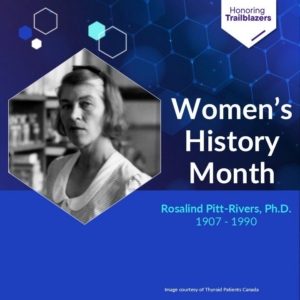
In celebration of Women’s History Month, Corcept is proud to honor Rosalind Venetia Pitt-Rivers, Ph.D. (1907–1990), a pioneering British biochemist whose work helped transform scientific understanding of hormone biology and its impact on human health.
Dr. Pitt-Rivers built her scientific career during a period when women were significantly underrepresented in laboratory research. In 1954, she was elected a Fellow of the Royal Society, one of the highest honors in science. She later became a founding member of the European Thyroid Association and served as its second President in 1971.
Throughout her career, she was known not only for scientific rigor but also for fostering collaboration and mentoring the next generation of researchers. Her leadership helped shape thyroid research across Europe and beyond.
Dr. Pitt-Rivers applied and leveraged innovative techniques for studying thyroid hormones, including radioisotope labeling, which allowed for more precise measurements and tracking of these hormones. Her seminal contribution came in late 1951 when she, alongside Jack Gross, co-discovered triiodothyronine (T3) — a more potent thyroid hormone than the well-known thyroxine (T4). T3 was effective in treating hypothyroidism. Their subsequent work fundamentally changed the understanding of thyroid hormone action and led to the development of treatments that are still used today.
Dr. Pitt-Rivers’ work contributed to a deeper understanding of how hormones function at the molecular level — insight that remains central to modern medicine. Today, hormone signaling is recognized as a powerful driver of both health and disease, influencing endocrinology, oncology, neurology, metabolic health and many other fields.
The foundational discoveries of scientists like Dr. Pitt-Rivers paved the way for the work we now do at Corcept, where we have studied and brought forward medicines focused on addressing the role of cortisol – a stress hormone – in serious diseases.