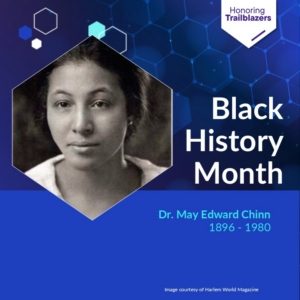
In celebration of Black History Month, we recognize the extraordinary contributions of Dr. May Edward Chinn. May was the first Black woman to graduate from Bellevue Hospital Medical College and the first woman of any race to respond to emergency calls with ambulance crews. Dr. Chinn was ahead of her time, breaking barriers that enabled her to contribute to the foundational research behind the Pap smear and to pioneer early cancer screening as a standard of care.
Born in 1896 to William Lafayette Chinn, a former slave, and Lulu Ann Evans, a Native American from the Chickahominy Indian Reservation, May Edward Chinn entered a world where she faced racial and gender discrimination. May’s mother was determined to provide her with an education. She worked at the Charles Tiffany Estate in New York, where May was educated alongside Mr. Tiffany’s children until Mr. Tiffany died. From that point on, May’s mother made it a priority to move the family to new locations where May would have access to the best educational opportunities.
In 1921, Dr. Chinn became the first Black woman accepted to Bellevue Hospital Medical College and was hired as an intern in 1926 at Harlem Hospital – an institution that, at the time, employed no Black doctors. Because Black physicians were denied admitting privileges or residencies at New York hospitals, Dr. Chinn entered private practice, making house calls and even performing surgeries when she was not seeing patients at the Edgecombe Sanitarium in Harlem. She developed an interest in cancer research, but since she was denied access to research information, she found a clever workaround by attending clinic visits with her patients as their family physician, where she carefully observed and learned about biopsy techniques.
In her work with patients, Dr. Chinn became convinced that there must be ways to detect cancer earlier. She continued learning about cancer screening, studying under George Papanicolaou, and is now widely known for contributing to the development of the Pap smear. She pioneered new approaches to physical exams and early cancer screenings as part of regular medical care – even in the absence of symptoms – and integrated the concept of family history to address cancer risk. Dr. Chinn joined the Strang Cancer Clinic – known for its cutting-edge cancer research – in 1944, where she worked until she retired in 1974. She became a member of the New York Academy of Sciences, was recognized for her work by the American Cancer Society in 1957 and was granted an Honorary Doctor of Science degree from New York University in 1980.
This Black History Month, we are proud to honor the tenacity, brilliance and empathy of Dr. Chinn. Her trailblazing contributions to gynecologic oncology have impacted millions of people globally.