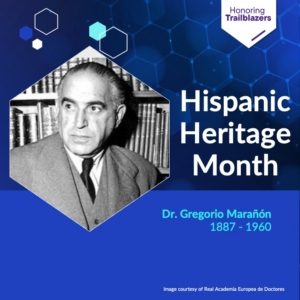
In celebration of Hispanic Heritage Month, Corcept is proud to recognize Dr. Gregorio Marañón (1887-1960), a pioneering Spanish physician, scientist and humanist who served as a founding father of modern endocrinology. Dedicating his life to uncovering the complex roles of human hormones, Dr. Marañón revolutionized internal medicine, authored foundational diagnostic texts, and advocated for compassionate care for underserved patients.
Early in his career, Dr. Marañón recognized that hormones play a central role in regulating metabolism, physiological function and overall human health. In 1910, he published landmark clinical studies on endocrine disorders — including early research on Addison’s disease, a rare condition caused by adrenal hormone deficiency.
Dr. Marañón built a prolific publication record throughout his career, authoring more than 2,000 articles, 500 scientific monographs and 40 books. Among his most influential works were his seminal text Endocrinology in 1930 and Manual of Etiologic Diagnosis in 1946, which became one of the most widely distributed medical books in the world. As professor of endocrinology at the Complutense University of Madrid, he established the Institute of Medical Pathology and the Department of Experimental Endocrinology, creating a premier center for hormone research.
Beyond his groundbreaking laboratory and clinical findings, Dr. Marañón was deeply committed to health equity and humanitarian service. Early in his career at the Provincial Hospital of Madrid, he voluntarily requested assignment to the infectious disease ward to care for vulnerable, impoverished patients — earning him widespread recognition as the “doctor of charity.” Dr. Marañón believed that true medicine required understanding the whole person — bridging endocrinology, psychology, ethics and history.
Today, Dr. Marañón’s memory endures at the Hospital General Universitario Gregorio Marañón in Madrid and across the global medical community. His pioneering research helped establish endocrinology as an essential pillar of modern medicine and demonstrated how targeted hormone research could revolutionize patient outcomes.
At Corcept, Dr. Marañón’s legacy resonates deeply with our mission. As we continue to advance the study of cortisol modulation and endocrine pathways to develop therapies for patients facing severe diseases, we honor visionaries like Dr. Marañón whose scientific rigor, empathy and commitment to discovery paved the way for modern endocrine care.
1. Zarate A. Gregorio Marañón, a pioneer of endocrinology, 50 years after his death. Gac Med Mex. 2011;147(2):176-179.
2. Roca AJ. An approach to Dr. Gregorio Marañón 61 years after his death. Revista Colombiana de Endocrinología, Diabetes y Metabolismo. 2021;7(4):302-307. doi:10.53853/encr.7.4.643
3. RAED. Academicians of our centennial history: Gregorio Marañón y Posadillo. Royal European Academy of Doctors. September 25, 2019. Accessed August 17, 2026. https://raed.academy/en/academicians-of-our-centennial-history-gregorio-maranon-y-posadillo/
4. Galarza and Vincentini M. Catholic Scientists: Gregorio Marañón, physician, historian and politician. Omnes. January 15, 2025. Accessed August 17, 2026. https://www.omnesmag.com/en/news/gregorio-maranon-physician-historian-and-politician/